


News

2026.06.23
As the demand for smart buildings, cybersecurity, and industrial facility management continues to grow, traditional single-factor access methods such as cards or passwords are no longer sufficient to address modern security threats. Two-Factor Authentication (2FA) Access Control has therefore become a key trend in next-generation access management systems. It enhances security by requiring users to verify their identity through two different authentication factors before access is granted.
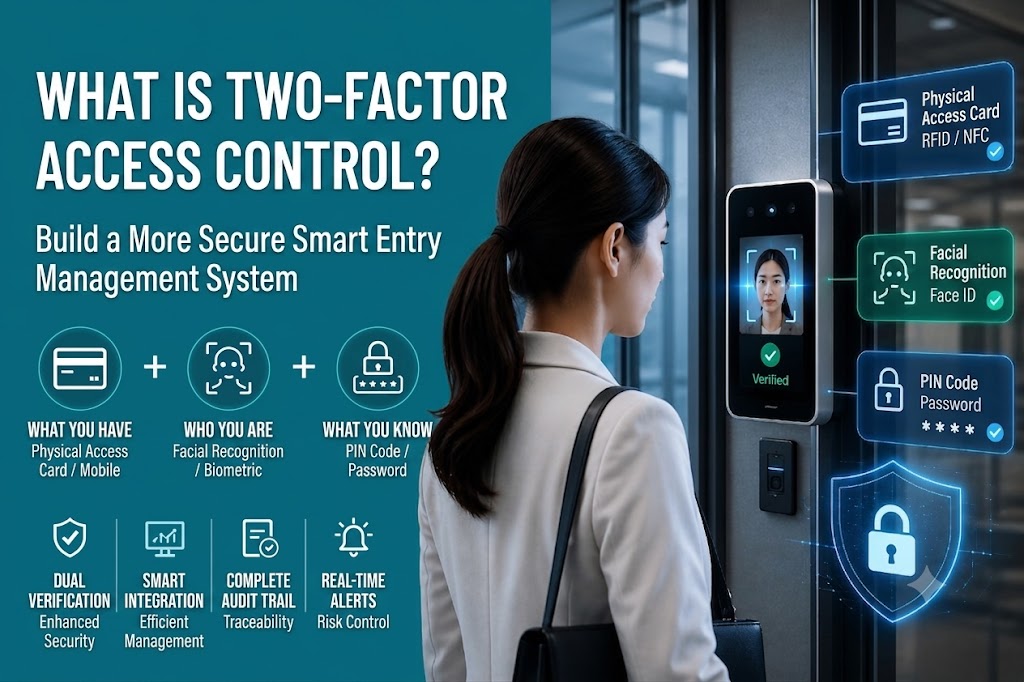
01 | The Three Primary Authentication Factors
Authentication methods can generally be categorized into three types:
Knowledge Factor
Something the user knows.
Examples:
- Passwords
- PIN codes
Advantages: Easy to deploy and widely adopted.
Limitations: Vulnerable to leaks, guessing, and phishing attacks.
Possession Factor
Something the user owns.
Examples:
- RFID or IC access cards
- Mobile credentials via Bluetooth or NFC
- One-Time Passwords (OTP)
- Security tokens
Advantages: Convenient and relatively secure.
Limitations: Devices can be lost, duplicated, or stolen.
Biometric Factor
Something the user is.
Examples:
- Facial recognition
- Fingerprint recognition
- Iris recognition
- Vein recognition
Advantages: Highly secure and difficult to forge.
Limitations: Requires specialized hardware and advanced AI recognition technology.
02 | What Is Two-Factor Authentication Access Control?
Two-Factor Authentication (2FA) combines two different authentication factors from the categories above. Users must successfully complete both verification steps before access is granted.
Common examples include:
Factor 1 – Something You Have
- Access card / RFID card
- Mobile app or digital credential
- QR code
- Smart wearable or security token
Factor 2 – Something You Are or Know
- Facial recognition
- Fingerprint recognition
- Iris recognition
- Password or PIN code
The door unlocks only after both authentication factors have been successfully verified.
03 | Why Implement Two-Factor Access Control?
Traditional access control systems face several risks, including lost cards, shared credentials, and password leakage. Once a single credential is compromised, unauthorized access becomes possible. Two-factor authentication significantly reduces these risks.
Key Benefits
Prevent Identity Theft
- Even if an access card is stolen, biometric verification can prevent unauthorized entry.
Enhance Security in High-Risk Areas
Suitable for:
- Technology parks
- Data centers
- R&D laboratories
- Government facilities
Improve Auditability
- Every access event is supported by dual verification records, making investigations and compliance audits more reliable.
04 | Common Two-Factor Access Control Combinations
-
Access Card + Facial Recognition
The most common combination, balancing convenience and security for offices and residential communities.
-
Mobile Credential + Fingerprint
Ideal for medium- to high-security office environments.
-
QR Code + Facial Recognition
Suitable for visitor management and temporary access authorization.
-
Password + Biometric Verification
-
Commonly used in highly restricted areas such as server rooms and critical infrastructure facilities.
05 | Real-World Applications
Two-factor access control is widely deployed across multiple industries:
- Corporate Offices – Employee and visitor access management
- Industrial Facilities – Protecting production lines and restricted zones
- Residential Communities – Enhanced resident and visitor security
- Data Centers – Protecting critical IT infrastructure and sensitive data
- Financial Institutions – Securing vaults, back-office operations, and sensitive work areas
06 | Advantages of Deploying 2FA Access Control
- Significantly enhanced security through dual verification
- Reduced reliance on manual management
- Integration with surveillance systems, VMS platforms, and AI analytics
- High scalability for future integrations such as ANPR, visitor management, and IoT systems
- Compliance with modern cybersecurity and regulatory requirements
Two-factor authentication access control is no longer just a security upgrade—it has become a foundational component of modern smart buildings and enterprise security strategies. By combining two independent identity verification methods with AI-powered analytics, organizations can achieve the optimal balance between convenience, security, and operational efficiency.
As the demand for smart buildings, cybersecurity, and industrial facility management continues to grow, traditional single-factor access methods such as cards or passwords are no longer sufficient to address modern security threats. Two-Factor Authentication (2FA) Access Control has therefore become a key trend in next-generation access management systems. It enhances security by requiring users to verify their identity through two different authentication factors before access is granted.
01 | The Three Primary Authentication Factors
Authentication methods can generally be categorized into three types:
Knowledge Factor
Something the user knows.
Examples:
- Passwords
- PIN codes
Advantages: Easy to deploy and widely adopted.
Limitations: Vulnerable to leaks, guessing, and phishing attacks.
Possession Factor
Something the user owns.
Examples:
- RFID or IC access cards
- Mobile credentials via Bluetooth or NFC
- One-Time Passwords (OTP)
- Security tokens
Advantages: Convenient and relatively secure.
Limitations: Devices can be lost, duplicated, or stolen.
Biometric Factor
Something the user is.
Examples:
- Facial recognition
- Fingerprint recognition
- Iris recognition
- Vein recognition
Advantages: Highly secure and difficult to forge.
Limitations: Requires specialized hardware and advanced AI recognition technology.
02 | What Is Two-Factor Authentication Access Control?
Two-Factor Authentication (2FA) combines two different authentication factors from the categories above. Users must successfully complete both verification steps before access is granted.
Common examples include:
Factor 1 – Something You Have
- Access card / RFID card
- Mobile app or digital credential
- QR code
- Smart wearable or security token
Factor 2 – Something You Are or Know
- Facial recognition
- Fingerprint recognition
- Iris recognition
- Password or PIN code
The door unlocks only after both authentication factors have been successfully verified.
03 | Why Implement Two-Factor Access Control?
Traditional access control systems face several risks, including lost cards, shared credentials, and password leakage. Once a single credential is compromised, unauthorized access becomes possible. Two-factor authentication significantly reduces these risks.
Key Benefits
Prevent Identity Theft
- Even if an access card is stolen, biometric verification can prevent unauthorized entry.
Enhance Security in High-Risk Areas
Suitable for:
- Technology parks
- Data centers
- R&D laboratories
- Government facilities
Improve Auditability
- Every access event is supported by dual verification records, making investigations and compliance audits more reliable.
04 | Common Two-Factor Access Control Combinations
-
Access Card + Facial Recognition
The most common combination, balancing convenience and security for offices and residential communities.
-
Mobile Credential + Fingerprint
Ideal for medium- to high-security office environments.
-
QR Code + Facial Recognition
Suitable for visitor management and temporary access authorization.
-
Password + Biometric Verification
-
Commonly used in highly restricted areas such as server rooms and critical infrastructure facilities.
05 | Real-World Applications
Two-factor access control is widely deployed across multiple industries:
- Corporate Offices – Employee and visitor access management
- Industrial Facilities – Protecting production lines and restricted zones
- Residential Communities – Enhanced resident and visitor security
- Data Centers – Protecting critical IT infrastructure and sensitive data
- Financial Institutions – Securing vaults, back-office operations, and sensitive work areas
06 | Advantages of Deploying 2FA Access Control
- Significantly enhanced security through dual verification
- Reduced reliance on manual management
- Integration with surveillance systems, VMS platforms, and AI analytics
- High scalability for future integrations such as ANPR, visitor management, and IoT systems
- Compliance with modern cybersecurity and regulatory requirements